
The United Kingdom joins the sustainable course: is your fleet ready for the maritime UK ETS?
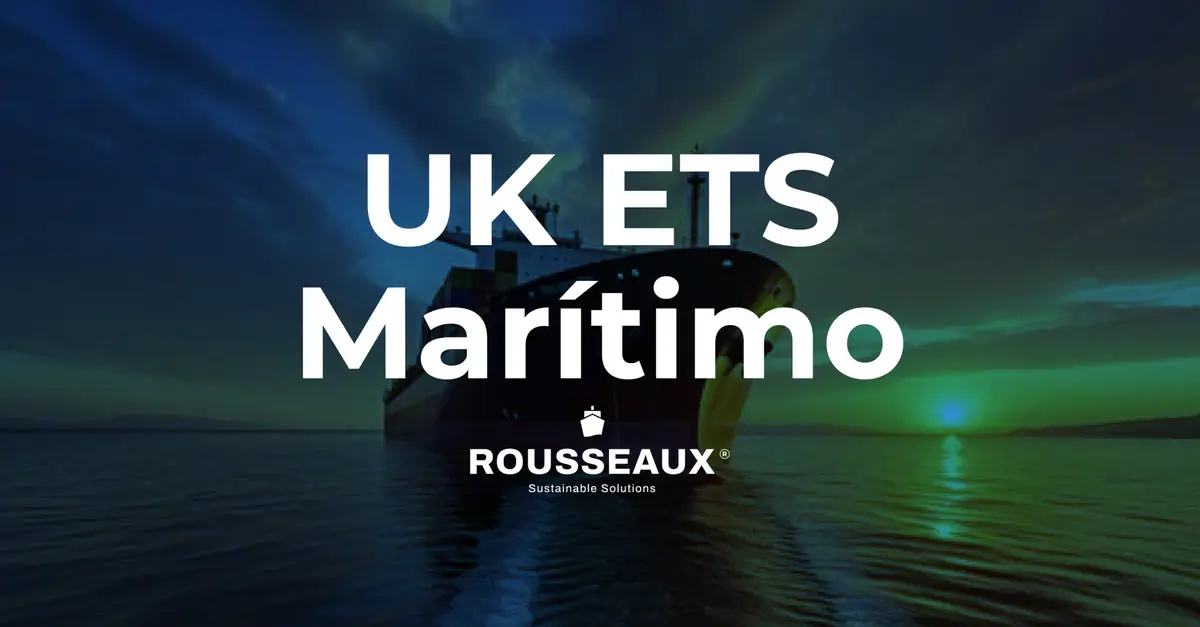
The United Kingdom has taken a key step in its net-zero strategy: from July 1, 2026, the UK Emissions Trading Scheme (UK ETS) will begin to apply to the maritime sector. The measure seeks to align shipping with the country's climate commitments and follows the trend already adopted by the European Union.
At ROUSSEAUX, we analyze what this new regulation means, who it affects and how we support fleets in this transition toward a cleaner, more efficient industry that is ready for the future.
What is the maritime UK ETS?
The UK ETS is a carbon pricing system that will require maritime operators to report their emissions and acquire allowances in proportion to their environmental impact. In this first phase, it will cover vessels above 5,000 GT making domestic voyages between UK ports or within a single port.
The emissions covered include not only those generated while underway but also at anchor or at berth, and extend to gases such as methane (CH₄) and nitrous oxide (N₂O), measured in CO₂ equivalents according to IPCC guidelines.
The scheme also provides for an Emissions Monitoring Plan (EMP) per company and an Annual Emissions Report (AER), along with a compliance regime, penalties and key dates for reporting and surrendering allowances.
"Sustainability stopped being a promise and became a technical and strategic responsibility. Fleets that understand this lead the way."
— Martín Rousseaux, CEO of ROUSSEAUX
Who is responsible?
By default, the responsible party will be the registered owner of the vessel, unless there is a legal agreement under which the ISM company formally assumes that role. This definition aligns with the EU ETS, reducing the administrative burden for companies operating under both systems.
What does the UK ETS exempt?
Non-commercial maritime activities carried out by the British government, such as military, customs, police, scientific or emergency operations, fall outside the scheme.
What does ROUSSEAUX offer?
In our role as an Eco-efficient Operations Center for the Maritime Industry, we offer technical and operational advice so your company is ready for the implementation of the UK ETS:
- Analysis of the regulatory impact and obligations by type of operation.
- Design and validation of the Emissions Monitoring Plan (EMP).
- Preparation of the Annual Emissions Report (AER).
- Support with credit management and contractual compliance.
- Training for technical teams and regulatory documentation adapted to the British framework.
- Integration of CH4 and N₂O monitoring under the new standards.
Why act now
Getting ahead of these changes is not only a matter of compliance. It is also an opportunity to optimize energy efficiency, reduce costs and strengthen shipping companies' environmental positioning in a market that is increasingly demanding on sustainability.
"It is not only about adapting to new rules, but about using them as an engine of transformation. In every new regulatory scheme there is a competitive advantage for those who know how to interpret it."
— Martín Rousseaux.
If your fleet operates in the United Kingdom or plans to in the coming years, at ROUSSEAUX we are ready to support you at every stage of the process of adapting to the maritime UK ETS.
The future of the maritime industry is already under way. And it is navigated with strategy.
Article published on August 13, 2025. The regulations mentioned may have changed since then.