
ROUSSEAUX in Honduras: a key contribution to driving maritime decarbonization in Latin America.
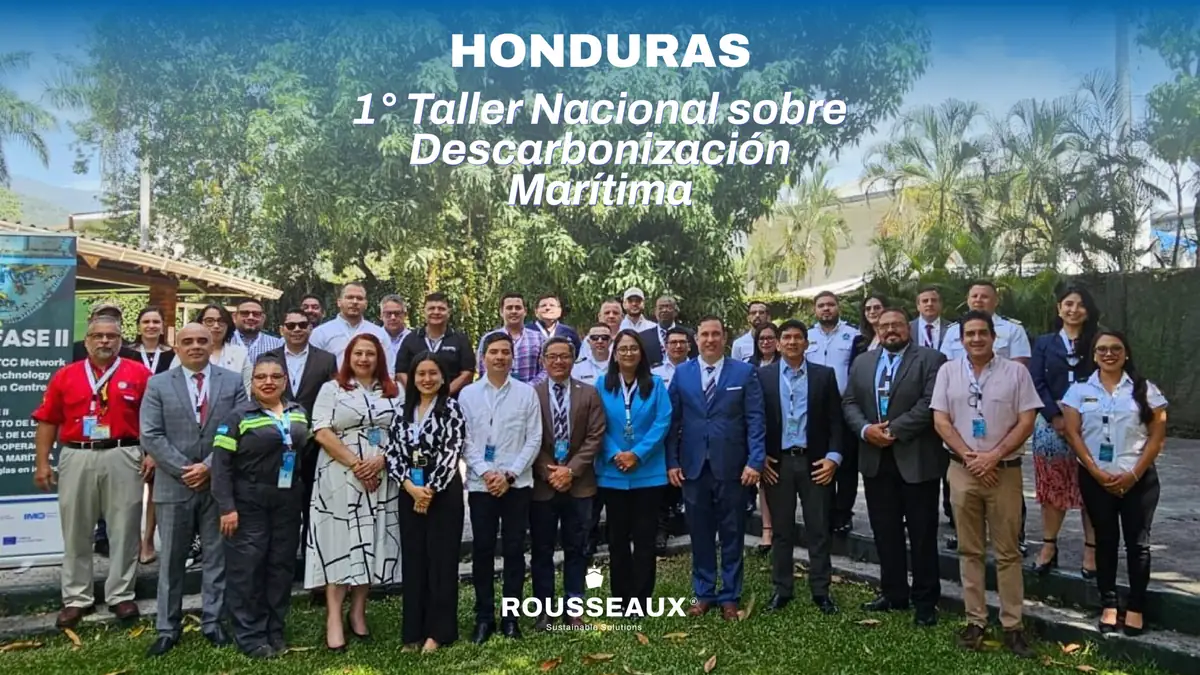
On May 29 and 30, 2025, the first “National Workshop of the GMN Phase II Project” in Honduras took place, a landmark event on the maritime sector's sustainability agenda. Organized by MTCC Latin America, Global Gateway and the IMO (International Maritime Organization), with the support of the European Union, the workshop focused on finding concrete solutions for decarbonizing maritime transport in the region.
The Argentine company ROUSSEAUX was an active part of the event, contributing its experience and strategic vision on energy efficiency, fuel transition and regulatory compliance. Martín Rousseaux, the company's CEO, was one of the main speakers and shared key ideas that set the course of the sector on the international stage.
A context of global urgency
The event falls within the global commitments assumed by the maritime industry, which must reach carbon neutrality by 2050 according to the targets set by the International Maritime Organization. In this scenario, Latin America stands out as a key region, both for its logistics potential and for the particular challenges it faces in infrastructure, access to technology and financing.
At ROUSSEAUX, we do not view this landscape from a distance but as a real opportunity to create positive impact through technical knowledge and concrete action. As Martín Rousseaux said in his address:
“What is at stake is no longer the future, it is the present of maritime trade. The energy transition is not an option, it is a path that has already begun, and those who lead this process today will be defining tomorrow's standards.”
ROUSSEAUX's contribution
During the workshop, the company shared experiences linked to technical measures and the relationships between regulatory, technical, operational and contractual aspects and other stakeholders. Exercises were carried out in which participants performed calculations related to Marine Fuel Life Cycle Assessment (LCA) regulations, along with a SWOT analysis of the sector and of Honduras in particular.
The fundamental role that public-private partnerships must take on at this stage of transformation was also emphasized, especially in countries with less access to technological tools. Rousseaux's experience advising ports, fleets, operators and authorities was highlighted as a replicable model adaptable to different contexts.
A vision that goes beyond regulations
Beyond regulatory compliance, Martín Rousseaux sees sustainability as an engine of competitiveness:
“We are at a time when the environmental and the economic are no longer opposed. Well-managed sustainability generates efficiency, attracts investment and opens markets. But above all, it gives the sector legitimacy in the eyes of a society that demands responsibility.”
Regional and international reach
ROUSSEAUX's participation in this national workshop reaffirms a clear strategic direction: to position itself as a key player in the energy transformation of the maritime industry, both regionally and internationally.
Events like this not only allow knowledge and good practices to be shared but also help build ties with authorities, multilateral organizations and strategic players in the Caribbean and Central America. Martín Rousseaux's contribution — with technical input and integrative reflections on the future of maritime transport — positions the company as a reference in operational sustainability, innovation and regulatory compliance.
“These spaces set the pulse of what is coming. Decarbonization is not only an environmental issue, it is a development agenda with geopolitical, economic and technological impact.” “True leadership lies in anticipating the inevitable. Every step we take today defines the place we will hold tomorrow in the international logistics chain.” said Martín Rousseaux during the event.
At the Company we understand that the challenges facing the countries of the region call for realistic, scalable and sustainable solutions. Our experience in regulatory advice, energy management, emissions monitoring and adoption of new fuels is a tool at the service of this transition.
That is why our international projection is not only an institutional goal but a professional responsibility: to be present, contribute solutions and help bring about the change the world already demands. With Honduras also as a starting point, the path to a more efficient, safer and carbon-neutral maritime industry becomes ever more concrete.
Article published on June 3, 2025. The regulations mentioned may have changed since then.